

AI for Engineers
Key Takeaways of AI for Engineers Course
Strong understanding of machine learning methods applied to real-world engineering problems.
Hands-on experience building and validating models, from setup and training to data visualization.
Apply AI-driven optimization and simulation to improve product design and development.
Use AI for autonomous control and intelligent operation of mechanical systems.
Identify high-impact AI use cases and implement the right AI frameworks.
Who Is This Course For?
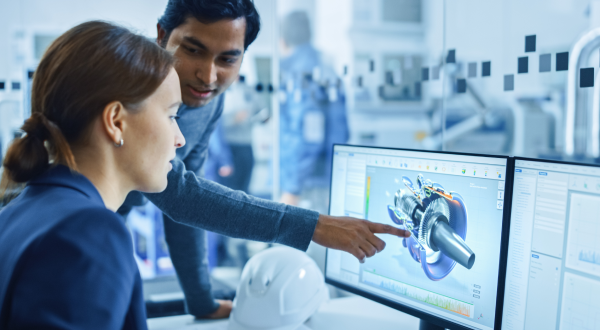
Engineers and engineering professionals looking to apply AI and machine learning to real-world engineering challenges, enhancing efficiency, performance, and innovation across design, manufacturing, energy, autonomous systems, and related fields.

Managers and executives in engineering-intensive organizations who want a clear, strategic understanding of how AI can drive innovation, operational transformation, and long-term business value.

Technical professionals with hands-on engineering experience who want to build practical AI capabilities and apply advanced machine learning techniques in engineering contexts, without requiring formal training in data science or software development.
Program Modules
Module 1: Introduction to AI and Its Applications in Engineering
Focus: Understanding where ML adds value in engineering systems.
What you learn
How ML reduces computational cost in physics-based simulations
How data-driven models accelerate design iteration
How ML enables exploration of high-dimensional design spaces
Pattern discovery in materials, components, and system performance data
What you do
Analyze real engineering use cases (wind turbines, battery electrodes, materials design)
Compare traditional simulation approaches vs. ML-augmented workflows
Articulate measurable engineering benefits of ML adoption
Skills you’ll build
Translating engineering problems into ML-amenable formulations
Technical communication of AI value to engineering stakeholders
Module 2: Machine-Learning Algorithms and Techniques
Focus: Turning an engineering process into an ML system.
What you learn
Supervised vs. unsupervised vs. semi-supervised vs. reinforcement learning
Data types common in engineering (sensor, time-series, images, logs)
Model lifecycle: training, validation, deployment, monitoring
What you do
Take a real engineering workflow (fault detection, inspection, monitoring)
Design a full ML solution:
Data pipeline
Model choice
Evaluation metrics
Deployment strategy
Skills you’ll build
ML system design thinking
Data readiness assessment
Model performance evaluation (metrics, validation strategies)
Module 3: AI Implementation— Data Practices and Parameter Tuning
Focus: Modern AI models engineers actually use.
What you learn
Deep learning architectures (ANNs, CNNs, RNNs) for engineering, image, and time-series data
Hyperparameter tuning, optimization strategies, and generalization tradeoffs
GAN fundamentals, including generator–discriminator dynamics and training challenges
What you do
Map deep learning models to different engineering data types
Tune and optimize models for performance, stability, and cost
Build and train a GAN from scratch in PyTorch using MNIST/CIFAR-10
Visualize model outputs, loss curves, and training behavior
Skills you’ll build
PyTorch model development
GPU-accelerated training
Debugging and interpreting deep learning models
Module 4: AI for Design and Optimization
Focus: AI for engineering design space exploration.
What you learn
AI-based design optimization concepts
Generative design principles
Prompt evolution and iterative optimization
What you do
Implement a simplified Prompt Evolution Design Optimization (PEDO) framework
Generate and optimize car designs in a Jupyter Notebook
Critically evaluate model outputs and propose improvements
Skills you’ll build
AI-assisted design workflows
Evaluating generative model quality
Engineering judgment applied to AI outputs
Module 5: AI for Autonomous Vehicles and Robotics
Focus: AI in control, robotics, and autonomy.
What you learn
AI for autonomous decision-making
Challenges in real-time systems
Tradeoffs in autonomy vs. safety and reliability
What you do
Analyze AI applications in autonomous vehicles and robotics
Discuss system-level challenges and opportunities
Skills you’ll build
Systems thinking for AI-enabled autonomy
Risk and limitation assessment
Module 6: AI for Manufacturing
Focus: Industrial AI for Industry 4.0.
What you learn
Autoencoders and denoising autoencoders
Reconstruction error–based anomaly detection
Model robustness and generalization
What you do
Implement autoencoders in PyTorch
Detect anomalies in synthetic manufacturing sensor data
Progress from basic implementation to advanced optimization:
Architecture tuning
Regularization (dropout)
Learning rate schedules
Performance metrics
Skills you’ll build
Industrial anomaly detection
Model tuning and experimentation
Practical ML troubleshooting
Module 7: AI for Energy Applications
Focus: Large-scale, real-world engineering impact.
What you learn
Predictive maintenance in energy systems
Sensor-driven ML pipelines
Cost-benefit and ROI analysis of AI systems
What you do
Design an AI predictive maintenance system for a wind farm
Select sensors, ML models, and deployment strategy
Estimate cost savings, uptime improvements, and ROI
Skills you’ll build
End-to-end AI system design
Engineering + business decision-making
Translating AI performance into financial outcomes
Module 8: AI for Biomedical Applications
Focus: Applying engineering AI skills in regulated, high-stakes domains.
What you learn
CNNs in medical imaging
Integration challenges across engineering and healthcare
Ethical and technical constraints
What you do
Analyze real medical AI applications
Assess integration challenges from an engineering perspective
Skills you’ll build
Cross-domain AI application
Ethical and technical risk assessment
Live Sessions Schedule
Live Session | Date & Time (UTC) | |
|---|---|---|
Week 1 | Orientation Webinar | June 3, 2026 | 12:30 PM |
Week 1 | Week 1 Office Hour | June 4, 2026 | 12:30 PM |
Week 2 | Week 2 Office Hour | June 11, 2026 | 12:30 PM |
Week 3 | Week 3 Office Hour | June 18, 2026 | 12:30 PM |
Week 4 | Week 4 Office Hour | June 25, 2026 | 12:30 PM |
Week 5 | Week 5 Office Hour | July 2, 2026 | 12:30 PM |
Week 6 | Week 6 Office Hour | July 9, 2026 | 12:30 PM |
Week 7 | Week 7 Office Hour | July 16, 2026 | 12:30 PM |
Week 8 | Week 8 Office Hour | July 23, 2026 | 12:30 PM |
Note: All session timings are in UTC. Session dates and timings are subject to change.
Instructor

Wei Lu
Professor, Mechanical Engineering | ME Associate Chair for Facilities and Planning
Wei Lu is a Professor at the Department of Mechanical Engineering, University of Michigan - Ann Arbor. He received his Ph.D. from Princeton University and his B.S. from Tsingh...
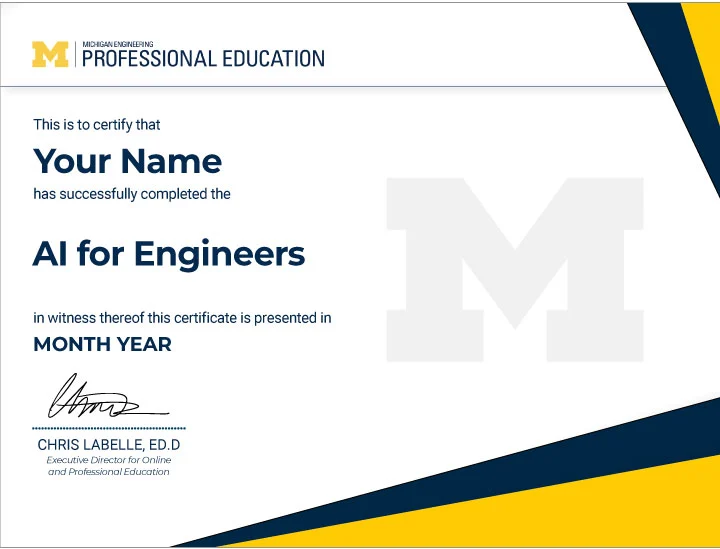
Digital Certificate
Upon successful completion of this course, participants will receive a certificate from the Michigan Engineering Professional Education. A digital badge is also awarded, which can be shared on LinkedIn or added to a professional portfolio.
Note: Certificates and digital badges are issued in the name used during course registration. Images are for illustrative purposes and may be updated at the discretion of the University of Michigan.
FAQs
Who is this course for?
AI for Engineers is designed for engineering professionals, graduates, and students across manufacturing, energy, automotive, aerospace, biomedical, and related fields, as well as technical managers and leaders seeking applied AI knowledge.
Do I need prior AI or coding experience?
No. The course begins with AI fundamentals and builds toward practical applications. In AI for Engineers, prior experience in AI or data science is not required.
Are there live webinars or interactive faculty sessions included?
Yes — AI for Engineers includes live webinars and interactive sessions with faculty and peers, giving you real-time insights, opportunities to ask questions, and direct engagement with instructors
What will I learn in this course?
You’ll learn how to apply AI and machine learning techniques to real engineering problems, including design optimization, predictive maintenance, autonomous systems, and data-driven decision-making.
How is this course different from other AI courses?
Unlike generic AI courses, AI for Engineers course is engineering-focused and application-driven, emphasizing hands-on projects, real-world case studies, and open-source tools.
What industries and use cases are covered?
The course explores applications across manufacturing, energy systems, robotics, autonomous vehicles, generative design, and biomedical engineering.
Is the course more technical or strategic?
The course balances both. In AI for Engineers course, participants gain hands-on technical exposure while also learning how to identify high-impact AI opportunities and communicate value within organizations.
How is the course delivered?
The course is delivered online over eight weeks, combining video lectures, assignments, discussion forums, and applied case studies.
How am I assessed?
Participants are evaluated through practical assignments (70%) and forum participation (30%), with a strong focus on applied learning.
What certificate will I receive?
Upon successful completion, learners earn a Certificate of Completion from Michigan Engineering Professional Education.
How will this course support my career growth?
AI for Engineers helps you future-proof your engineering skill set, enabling you to contribute to AI-driven initiatives and drive innovation in engineering-led organizations.
Are any taxes applicable to this program?
Applicable taxes will be calculated and added at checkout in accordance with country/state regulations.
Connect with a Program Advisor for a 1:1 Session
Didn't find what you were looking for? Schedule a call with one of our Program Advisors or call us at +13159021796.
Register now and boost your professional trajectory.
Enroll by