

AI & ML for Leaders: Foundations & Lifecycle Frameworks
Course Overview: AI & ML for Leaders
The AI & ML for Leaders: Foundations & Lifecycle Frameworks course provides a clear, structured understanding of how AI and ML systems are designed, trained and evaluated across their full lifecycle. The curriculum equips you to guide machine learning initiatives with confidence, whether you are shaping strategy, partnering with technical teams, or overseeing system outcomes.
Through real case studies, applied analysis and instructor‑led discussions, you will build the vocabulary, mental models and decision frameworks needed to collaborate effectively with engineers and data teams. By the end of the course, you will be able to interpret data‑driven workflows, navigate iterative ML development cycles, and support AI initiatives that create meaningful impact in engineering and scientific environments.
What You Will Learn in the AI & ML for Leaders Course
Module 1: The Mindset of an AI Project Manager
You explore the role of an AI project manager, key terminology, common misconceptions, and the core skills needed to guide technical teams. You also learn through the Tesla Full Self Driving case study.
Topics include:
Role of an AI project manager
Misconceptions and core skills
Process and mindset
Tesla Full Self Driving workflow
Challenges such as evolving timelines and leading technical experts
Module 2: Data Acquisition and Processing
You learn the complete data lifecycle, from collection to improvement, and how to evaluate data quality for effective ML outcomes. You also compare building models from scratch with improving existing ones.
Topics include:
Importance of data and data types
Data collection methods
The AI project lifecycle and analysis
Improving vs. creating ML solutions
Tennis case study on data improvement
Module 3: Training AI and ML Models
You understand how ML models learn, how to frame feasible ML tasks, and how data representation influences model behavior. You also explore multimodal systems.
Topics include:
Framing AI tasks
Input–output model view
Feasible vs. impossible tasks
Supervised learning and model training
Multimodal AI systems and their applications
Module 4: How ML Engineers Train and Refine Models
You see how engineers use training and test data, interpret learning patterns, and refine models to address issues like underfitting and overfitting.
Topics include:
Training vs. test data
Memorization vs. generalization
Accuracy and loss behavior over time
Training processes and classification examples
How engineers evaluate learning quality
Module 5: Evaluating an ML Model
You learn how to assess model performance, identify failure cases, and apply improvement strategies such as augmentation, synthetic data, and transfer learning.
Topics include:
Generalization, accuracy, and performance metrics
Failure case analysis
Tank Detection failure story
Handwritten digit recognition activity
Data augmentation and synthetic data
Transfer learning for limited data scenarios
Module 6: Best Practices, Ethics, and Privacy
You explore ethical, legal, and human-centered considerations that support responsible AI deployment.
Topics include:
Reproducibility and benchmarking
Reducing dataset bias
Coaching and leadership in AI/ML projects
Creating an AI-curious culture
Ethical and responsible AI/ML practices
Learning Outcomes: Driving AI & ML Impact with Confidence
By the end of this course, you will be able to:
Define an AI problem and determine the data needed to train and evaluate a model
Use essential AI and ML terminology to communicate effectively with technical teams
Understand how engineers build, train, and refine ML models and how data shapes performance
Evaluate ML models and identify improvements using both technical and human-centered approaches
Oversee and enhance the full ML lifecycle to ensure reliable and strategically aligned outcomes
Key Highlights

Live Sessions with the Instructor

Case Studies and Real-World Applications

Hands-On Activities and Guided Analysis

Technical Workflow Understanding

Ethical and Responsible AI and ML Practices

Michigan Engineering Professional Education Certificate
Live Webinars with Instructor
Experience live, interactive sessions that explore how AI is transforming product management and strategic decision‑making. The webinar covers practical approaches to integrating AI into product development, enabling effective human‑AI collaboration and leveraging modern tools to accelerate productivity and innovation.
Note: Live session details are subject to change and may be updated based on faculty guidance.
Who Is This Course For?
This course is ideal if you want to lead or support AI and ML initiatives in engineering or scientific environments. It is designed for:
Business and cross‑functional leaders collaborating with data science and ML teams
Nontechnical professionals who need to understand ML processes, results and risks
Product, strategy or operations professionals exploring AI-enabled opportunities
Technical stakeholders transitioning into AI‑aligned roles
Project managers and team leads overseeing ML‑powered initiatives
Note: No prior technical or ML experience is required.
Live Sessions Schedule
Live Session | Date & Time (UTC) | |
|---|---|---|
Week 1 | Orientation Webinar | June 3, 2026 | 4:00 PM |
Week 1 | Week 1 Office Hour | June 4, 2026 | 4:00 PM |
Week 2 | Week 2 Office Hour | June 11, 2026 | 4:00 PM |
Week 3 | Week 3 Office Hour | June 18, 2026 | 4:00 PM |
Week 4 | Week 4 Office Hour | June 25, 2026 | 4:00 PM |
Week 5 | Week 5 Office Hour | July 2, 2026 | 4:00 PM |
Week 6 | Week 6 Office Hour | July 9, 2026 | 4:00 PM |
Note: All session timings are in UTC. Session dates and timings are subject to change.
Meet Your Instructor

Raj Rao Nadakuditi
Associate Professor of Electrical Engineering and Computer Science, University of Michigan, Ann Arbor
Professor Raj Rao Nadakuditi is an Associate Professor in the Department of Electrical Engineering and Computer Science at the University of Michigan. He earned his master’s a...
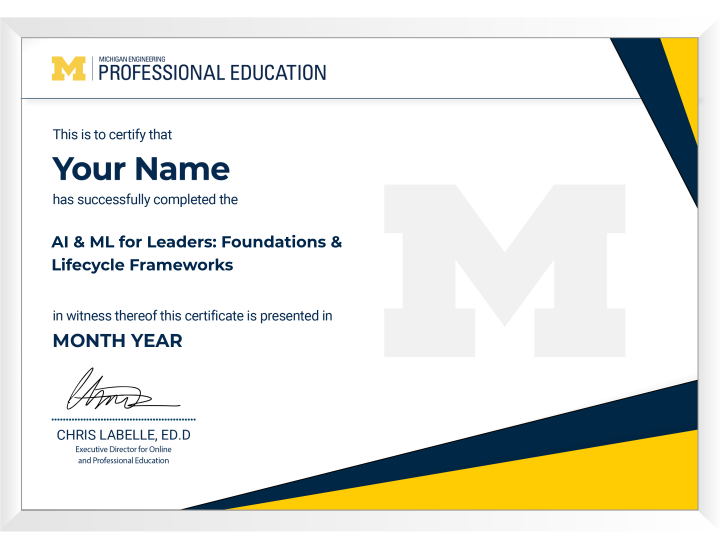
Certificate
Upon successful completion of this course, participants will receive a certificate from the Michigan Engineering Professional Education. A digital badge is also awarded, which can be shared on LinkedIn or added to a professional portfolio.
Note: Certificates and digital badges are issued in the name used during course registration. Images are for illustrative purposes and may be updated at the discretion of the Michigan Engineering Professional Education.
The Michigan Difference
#1
#3
#18
Frequently Asked Questions
Do I need a technical background to succeed in this course?
No. The course is designed for non‑technical and semi‑technical leaders. You will learn AI and ML concepts, workflows and terminology without needing prior coding or engineering experience.
Will I learn how to build or code machine‑learning models?
This is not a coding‑heavy program. Instead, it focuses on understanding how models are designed, trained, evaluated and deployed, so you can effectively lead, oversee or partner with ML teams.
What kind of case studies does the course include?
The course uses cross‑industry examples, including Tesla, customer‑support ML systems, AI failures and bias scenarios, It also takes reference cases from companies like Microsoft and Amazon. These help illustrate real‑world challenges, trade‑offs and lifecycle decisions.
How interactive is the program?
Learners participate in instructor‑led sessions, guided analysis and practical exercises. Live webinars, discussions and hands‑on walkthroughs ensure strong engagement and applied learning.
What will I be able to do after completing the course?
You will be prepared to define AI problems, evaluate model performance, collaborate with technical teams, oversee ML development cycles and support AI initiatives with confidence and strategic insight.
Who is this course best suited for?
The program is ideal for business leaders, cross‑functional partners, non technical professionals and project managers working with ML-driven initiatives—especially within engineering and scientific environments.
Will I receive a certificate?
Yes. Upon successful completion, participants receive a certificate from Michigan Engineering, recognizing expertise in AI & ML leadership foundations and lifecycle frameworks.
Are the industry examples full case studies?
No. Industry examples (e.g., Microsoft, Amazon) are included as supporting references and recommended readings rather than full, in‑depth case studies.
Are any taxes applicable to this bundle?
Applicable taxes will be calculated and added at checkout in accordance with country/state regulations.
Connect with a Program Advisor for a 1:1 Session
Didn't find what you were looking for? Schedule a call with one of our Program Advisors or call us at +13159021796.
Register now and boost your professional trajectory.
Enroll by